
Hamlets and localities
- The Bannstein farm is located on the road to Philippsbourg.
- The annex of Bellerstein, formerly called Gauchshardt, had a sawmill.
- Bronnenthal, Bruch, Buckelhans, Dachseck, Gauchsmatt, Grossthaler Ebene, Hoffeld, Igelsberg, Kaldenthal, Rehkoepfel, Sandkopf, Schindelberg, Schlossmatt, Weiherecken and Wolfseck.
- The house of the Eichelsberg annex was built in 1845.
- The Erbsenthal annex, located near the Erbsenberg and the Erbsenfelsen, dates from the beginning of the 19th century.
- The hamlet of Schweizerländel, made up of a few houses near the Schweizerkoepfel, dates from the middle of the 18th century.
- The former annexes of Hof and Hubel, formed in the middle of the 19th century, are now part of the village.
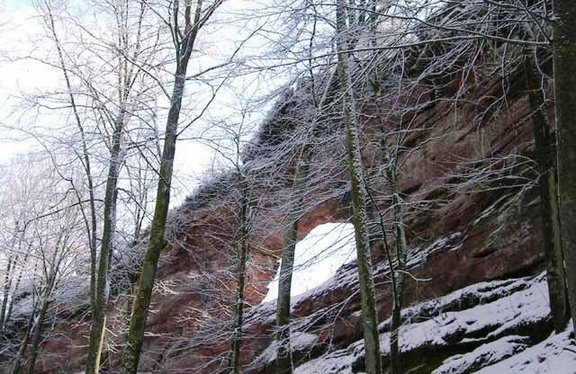
- The characteristic Kandelfelsen rock is located on the slope of the Kandelberg.
- The Neuzinsel farm, rebuilt by the monks of the Cistercian Abbey of Sturzelbronn on the site of a former village that disappeared around 1720-1730, is recorded as being leased out around 1758. It was farmed over an area of thirty-two hectares until 1880, then acquired by the Water and Forestry Administration in 1876, during the German annexation.
- The hamlet of Waldeck has been mentioned since 960.
- The Glasbronn annex dates from the beginning of the 19th century.
- The Mill, already recorded in 1594, whose ruins are confirmed in the survey deed of 2 January 1721. It was rebuilt around 1730 and continued to operate until around 1855-1860. Next to the mill stood a sawmill which ceased operating in 1945.
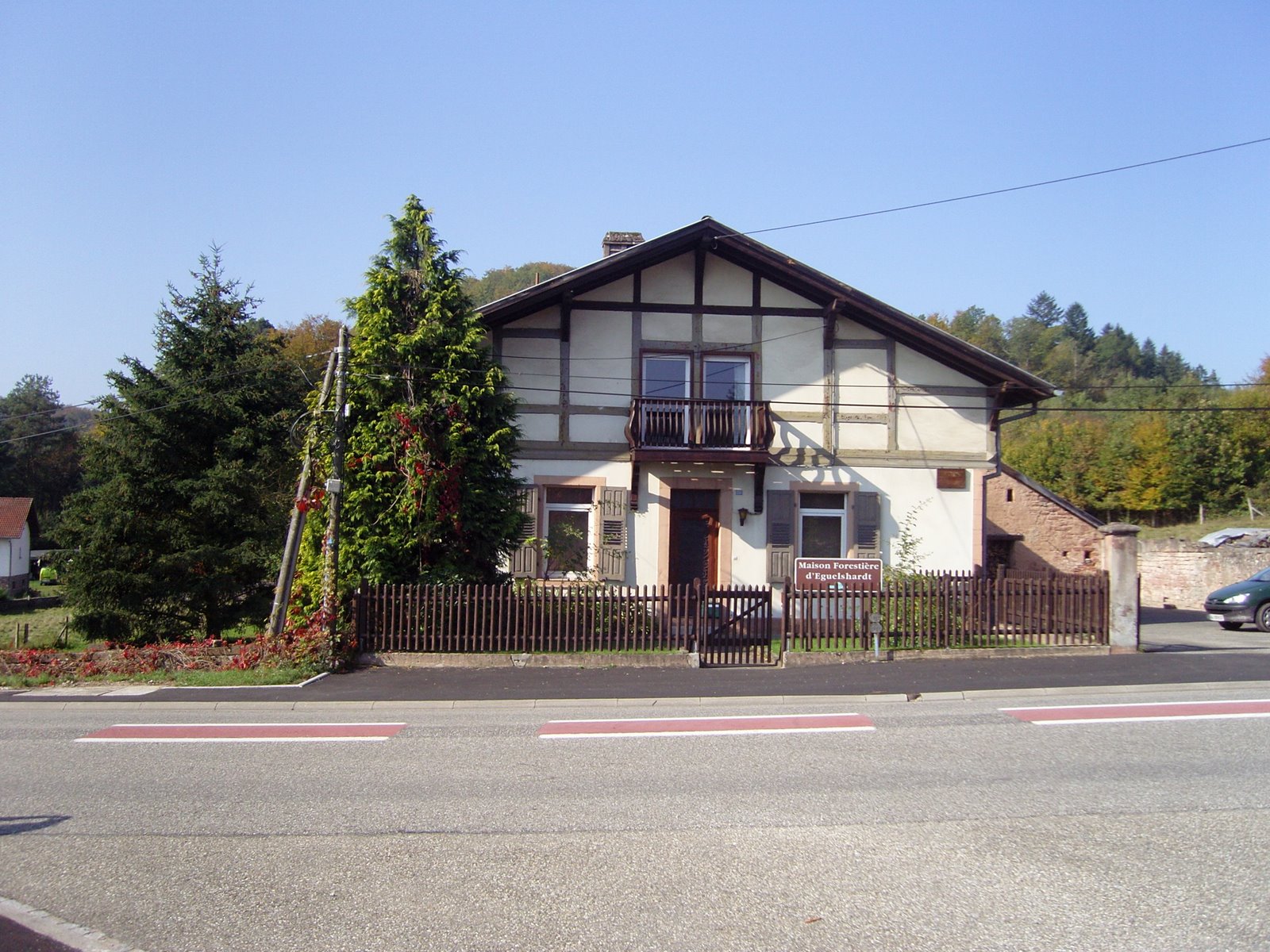
- The Armsberg forester's house was demolished in 1890.
History
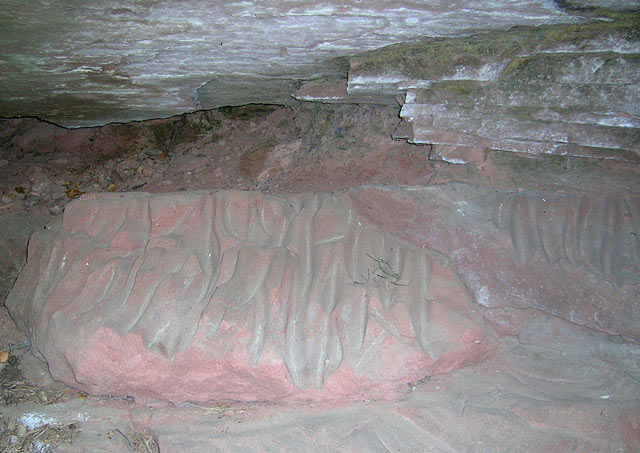
Prehistoric polishing stones, visible in the centre of the village, show that the site of the wide valley has been occupied since very ancient times. The name of the village is mentioned in its present form in 1329, Eguelshardt, from the Old German Hard, the wooded pasture, and Egel from Egala, the leech. The village was later recorded in 1592 as Egelsshart, in 1751 as Egelshardt, Igelshard in 1755, Igelshart in 1771 and Egelsharde at the end of the 18th century. It became Egelshardt during the German annexation of 1871, a name changed to Eguelshardt on the return to France in 1918, then back to Egelshardt from 2 August 1940, before regaining its present spelling in 1944. In 1337 Waldeck Castle passed to the Zweibrücken-Bitche family and then, in 1571, to the Duke of Lorraine. Eguelshardt was a castle and fief and then, from 1594, a mairie (administrative district) of the lordship of Bitche together with the former fiefs of Gentersberg and Waldeck.
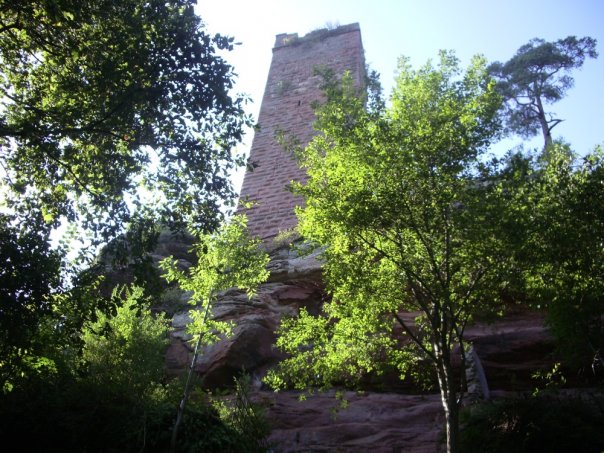
The village is recorded in the 16th century, with a church, as a fief of the Lords of Ettendorf, in nearby Alsace. In 1592 the Eguelshardt farm was recorded as being in ruins. In 1603 work began on setting the stones marking the border between the County of Hanau-Lichtenberg and the Duchy of Lorraine. Waldeck Castle became part of the Duchy of Lorraine in 1606. In 1606 repair funds were allocated to repair the farm, destroyed by acts of war. After the Thirty Years' War (1618-1648), in 1661, the village was still abandoned and completely destroyed. In 1635 Waldeck Castle was dismantled by the French troops of Marshal de La Force. In 1708 Eguelshardt and Waldeck each had three families, about thirty-five people, then around ten families in 1732. In 1750 there were one hundred and fifty souls.
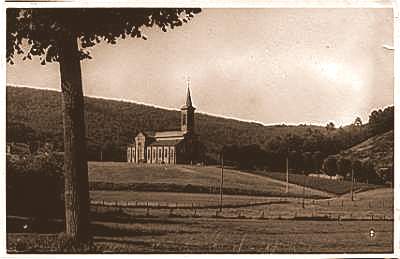
Eguelshardt and its dozen or so hamlets grew into a village in the 18th century thanks to the development of industrial activities along the Falkensteinerbach: sawmills, forges, paper mills and mills. In 1732 the village, of recent origin, was still mentioned as a simple farm. The municipality became part of the canton of Bitche when it was created by the revolutionary government in 1790. During the Second World War, the inhabitants were evacuated to Saint-Simon, in the Charente, on 1 September 1939. The village was bombed in December 1944 and liberated on 28 March 1945 by American troops. The Croix de Guerre with bronze star was awarded to the municipality for « its sacrifices, the help given to escaped prisoners of war and its attachment to France ». Several old pictures show what the village looked like in the past, at the beginning of the 20th century, and also show how the municipal heritage changed during the heavy destruction caused by the fighting and bombing of the Second World War.
source: http://www.bitscherland.fr/Canton-de-Bitche/Eguelshardt/eguelshardt.html