Conscripted into the R.A.D with my friend Alfred Schwartz on 10 June 1944 in Waldfischbach. The story of Jean-Pierre Letzelter
The Reichsarbeitsdienst (abbreviated RAD, Reich Labour Service) was an organisation of the National Socialist power apparatus of the Third Reich from 1933 to 1945. From June 1935, every young man and young woman was obliged to complete six months of labour service before military service.
First escape
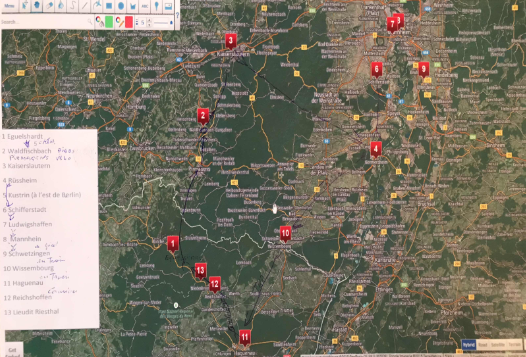
The first escape took place on 30 April 1944, in the evening at 11 pm. We were arrested while passing through Pirmasens during a « Fliegeralarm » (air-raid alert).
Captured
We were taken back by the gendarmerie to the camp at Waldfischbach, where the whole company had been assembled to receive us. The Oberfeldwebel (chief warrant officer) presented us as deserters, saying: « Schaut euch mal diese Krucken da an, sie werden als Kriegsverbercher verurteilt » (Look at these cripples, they will be tried by court martial). We were then locked in a small room whose windows had been nailed shut with planks. We had to sleep on the bare floor on a single blanket; we were treated like criminals.
On 10 September 1944 the camp was moved to Kaiserslautern because the Allies were getting closer. The two of us were locked in a room for 2 days with nobody looking after us, almost nothing to eat and a bucket for a toilet. The good life, eh!
After a few days, a stroke of luck: one fine Sunday morning they came to fetch us to clean out a stable for 10 horses that had not been cleaned for a very long time. That kept us busy for the day.
A few days later we changed camp, to Russheim (near Germersheim), on the far side of the Rhine.
The next day both of us changed jobs. Alfred was appointed « Schweine Ordonanz » (pig orderly): he had to look after a dozen pigs. As for me, I was luckier, as I was made kitchen assistant: peeling potatoes, cleaning vegetables and above all keeping the kitchen « picobello », always spotlessly clean. Not too bad! At least we had something to eat. Still unguarded, a few days later we were given the job of cleaning the Oberfeldwebel's office. From the very first day I had spotted the leave passes and the stamp that went with them, which would one day allow me to go home. For the slightest little thing he would open the door of the office, which always had to be spotless, and shout: «Arbeitsmann Hans sofort in's Bureau». As I was a well brought-up and obedient boy, we got on well. One day I nevertheless managed to get hold of (illegally) a leave pass and, the icing on the cake, to stamp it with the camp stamp. This theft was a great help to us in our second escape.
Alfred had a lot of work with his herd of pigs. He was given a horse to collect kitchen scraps from the surrounding camps and to go for rides in a carriage.
None of this lasted long.
On 11 November 1944: Stellungsbefehl (call-up order) into the Wehrmacht, at Küstrin.
On 12 November 1944 we moved to Schifferstadt to join the train convoy to Küstrin (Brandenburg, east of Berlin). The convoy was made up of young men returning from 4 weeks' leave after the Arbeitsdienst, so all in civilian clothes. As we were escapees, we were not entitled to this leave and were drafted straight into the army in our Arbeitsdienst uniforms.
On 13 November we left under armed guard, since I was a deserter, from Schifferstadt station, with the order: « Jeder Fluchtversuch wird erschossen » (Anyone who tries to escape will be shot). On arrival in Ludwigshafen, we changed trains for Mannheim.
On arrival in Mannheim, the Fliegeralarm siren sounded and everyone went down into the Luftschutzkeller (air-raid shelter). This was the moment to risk everything and escape.
The second escape
Having been given permission to go to the toilet, I left on foot with my comrades, leaving our little kitbags behind, heading towards... "freedom".
Along the way people asked us where we were coming from and where we were going; the answer was always the same: Versprengte Truppen, wir suchen unsere Einheit! (Scattered troops, we are looking for our unit!)
After 2 hours of walking we arrived in Schwetzingen. There, some seamstresses offered us coffee. Our main concern was getting back to France. Looking at the timetable of trains leaving for Alsace, we saw that the first one was at 7 pm.
As we were boarding the train, the Feldgendarmerie (military police) were carrying out checks, and that is where the stolen leave pass saved our lives. I briefly showed them the pass and they told us to get on the train quickly. You have to understand that the platform was packed with people. We spent the night in Wissembourg station to catch the 7 am train to Haguenau.
But in Haguenau there was no connecting train to Bitche before the evening. We decided to carry on by road. Leaving the station on foot, we had breakfast in a bakery near the bridge on the Bitche road in Haguenau. It was the baker's wife, standing in the doorway, who asked us where we had come from and where we were going. When she heard our story she sympathised, because she was waiting for a son who had also escaped, and she gave us breakfast.
There, a lorry driver gave us a lift as far as the De Dietrich factory in Reichshoffen.
From there, two friends, Oberhauser from St Louis and Stenger from Goetzenbruck, went home their own way, on foot.
Alfred Schwartz and I, both from Eguelshardt, stayed with an aunt in Reichshoffen until the evening, intending to go home by train.
At the crossroads, a German driver stopped with a lorry running on producer gas from a wood fire (Holzgas).
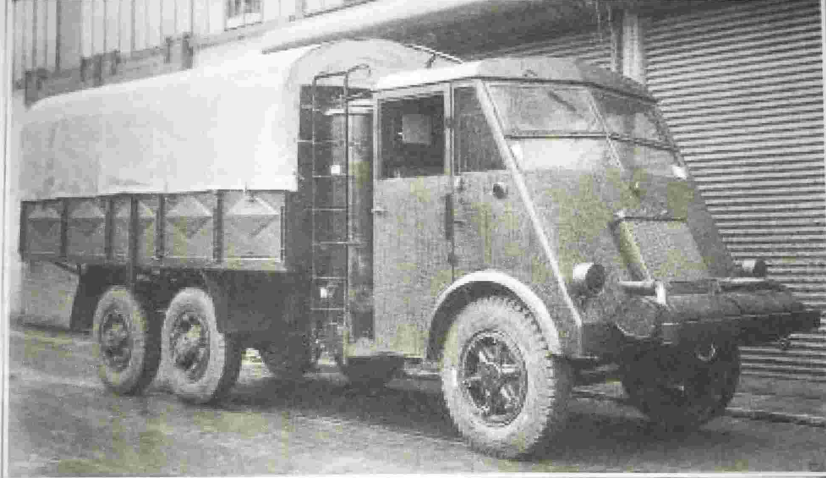
The gas generator (gazogène), invented in the 19th century, is a device that produces a combustible gas by pyrolysis of solid fuels: wood (wood gas), charcoal, coke, anthracite, etc. It can power so-called « producer gas » engines, conventional combustion engines or boilers.
This system, in the form developed by Georges Imbert in 1920, was used in Europe to make up for the lack of motor fuel during the Second World War. It is indeed a simple device to build, requiring only easily obtained materials. Source: https://fr.wikipedia.org/wiki/Gazog%C3%A8ne
As my friend owned a tractor running on Holzgas, he knew that these lorries could barely move on the slightest slope. We immediately decided to climb into the lorry without the driver knowing, hiding under the tarpaulin, telling ourselves that on the climb up the Pfaffenberg it would be easy to jump off. After a quarter of an hour the driver set off again, unaware that he had stowaways on board. Between Niederbronn and Philippsbourg, at the place called Riesthal, he stopped to put more wood in his machine. As it was dark and we did not move, he drove on without seeing us. We breathed a huge sigh of relief.
When we reached the entrance to Eguelshardt, at the place called «Am Kreuz», there was a slope and the lorry slowed down. Alfred said to me: « Now's the moment, let's get off! ». No sooner said than done!
We crossed the railway line and followed the edge of the forest. Suddenly a dog barked close by. Our first thought: « We've been on the run for two days, we're 1 km from home, and now we're caught for the second time, given away by a Gestapo dog! »
After a few seconds frozen to the spot, we set off again without a word or a sound, following the edge of the forest to the house of one of Alfred's aunts, who lived at the edge of the woods.
When we reached the house we listened at the door. What a shock! Aunt Anna, a widow who lived alone, was talking to a man! After quite a while this man, the Bannstein stationmaster, who rented a room there, left.
As Aunt Anna was locking the door, Alfred called out to her to tell her that we had escaped. Without letting us into the house, she made us understand that we were to wait for her in the shed where the wood was stored. She came back wearing a big coat and holding a milk churn. She went to ask her brother, who lived 200 m away, to take Alfred to his parents, who lived 600 m away in the village. Alfred left with his uncle while I followed his aunt, who pretended to be going to fetch milk from my parents. We crossed the guarded bridge without difficulty, as the guards knew her: she fetched her milk every day.
In hiding
The escape had succeeded, but it was now that I ran the greatest risk, because I had to hide so as not to be found and above all so as not to endanger my family. An uncle and his two daughters had come from Thionville to take refuge with my parents, as he thought they would be safer in the countryside than in the town. Because of this I could not show myself, as the girls, aged 10 and 14, might have given me away without meaning to.
The next day my brother René went to see a forest ranger at Biesenberg, for whom I had done a lot of work, to ask him whether he could hide me at his home. Mr Provot agreed, and that same evening my brother and I, two on one bicycle, covered the 6 km to the Biesenberg forester's house.
After 4 weeks at Biesenberg with Charles, another deserter, I went back to my parents'. On the way, a salvo of shells fired by the Americans exploded around us. As there are many small rocks in our forests, we were able to take cover until things calmed down. After half an hour we were able to carry on, and we reached home at nightfall.
The further the American army advanced, the more the bombing and shelling intensified. The civilians barricaded themselves in their cellars while the German soldiers made themselves masters of the houses. So for us, the draft dodgers in hiding, it was impossible to move. Knowing that the Americans were advancing, albeit slowly, from Niederbronn, we hoped to be liberated soon. Unfortunately the liberators stopped at Bannstein.
Eguelshardt remained under German control while Bannstein was under American control. As a result Eguelshardt became the front line, and therefore the target of the bombs and shells of both sides. Christmas was approaching and everyone believed liberation was near.
Unfortunately, on the night of 31 December to 1 January the German army launched a counter-offensive and the American army had to give ground.
This was very sad news for the village's 28 draft dodgers in hiding. Some went over to the Americans, while others like me stayed hidden in lofts under piles of hay, or in cellars under potatoes or beets. Before Christmas a 3rd deserter (Raymond) had joined us, as he could no longer hide at his parents'. So we decided to go into the forest, to a shelter that other « hidden men » had built before leaving it.
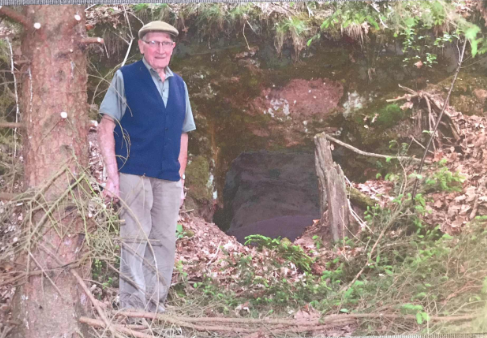
Despite the cold, we lit very little fire in the evening and certainly none during the day, as the smoke could have betrayed our presence. I remember that in February it was cold but sunny, and to make the most of the warmth we did not hesitate to climb the trees.
Once a week we went home to fetch food and a large demijohn of water, which we had to carry back to our hiding place by a different path each time so as not to leave tracks and be found.
Liberation
We lived in hiding until the liberation of the village on 16 March 1945.
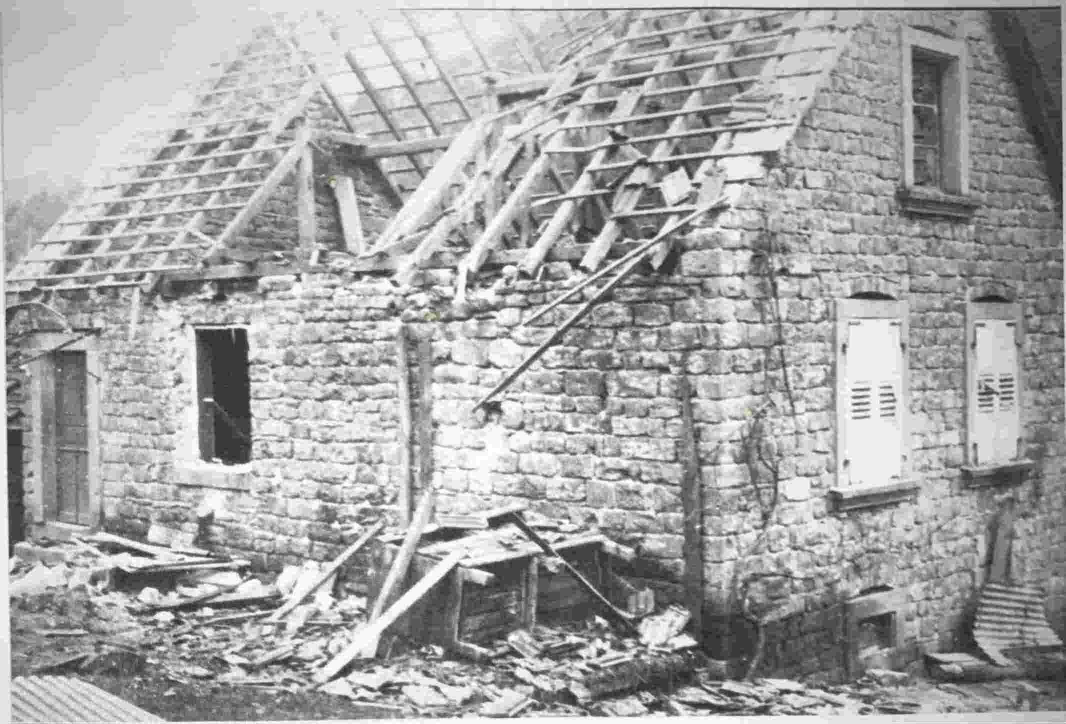
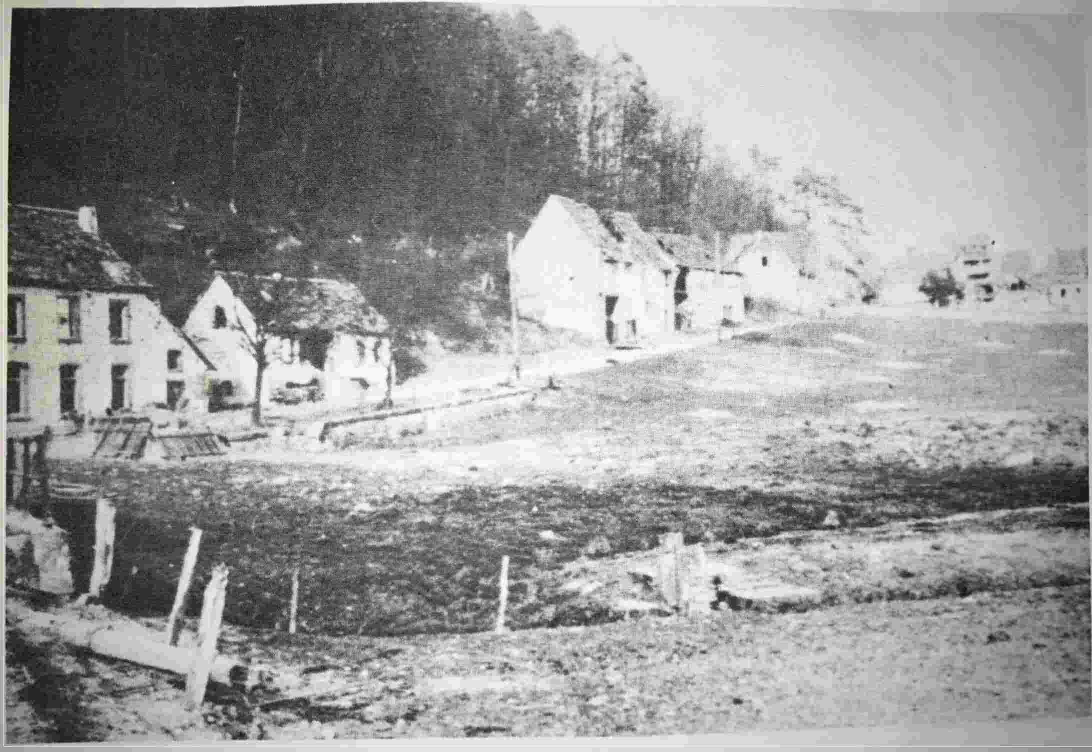
When we returned to the village, we could see the damage our houses had suffered in the bombing.