
A WORD FROM THE MAYOR – THE GRAZING ASSOCIATION FAILS
(Hirtenverein in den Binzen)
Although the majority conditions laid down in article L 135-3 of the Rural and Maritime Fishing Code had been met for creating the Landowners’ Grazing Association in the Falkensteinerbach valley, covering Bitche, Eguelshardt and Philippsbourg, the Prefect rejected the application on 21 October 2013 on procedural grounds. At the meeting held in Philippsbourg on 13 September 2013, which marked the end of the owners’ consultation, the project’s initiators were unable to present the figures of the consultation to those present. The Moselle Mountain Economy Association (AMEM), commissioned by the municipalities to carry out the survey, did not bring the expected figures to the meeting and only supplied them on 19 September 2013. This is grounds for rejection.
The Prefect is, however, not opposed to a new project being put to public inquiry.
But given that, in this first inquiry, Eguelshardt recorded significant opposition in terms of area, it seems preferable to exclude it from the AFPA perimeter. Any new project should therefore be limited to Philippsbourg alone.
Our owners would have preferred the AFP study to include the issue of draining the ponds and managing the stream (dredging and restoring the banks and the bed), since these determine the quality of the surrounding grazing land. This was not possible, as managing stream beds is the responsibility of the Community of Municipalities, which has not made restoring the Falkensteinerbach a top priority.
Finally, some livestock farmers see the AFP as an association that would impose a management style they find too “collectivist” and would let others interfere in how they farm – or do not farm – their land, none of which they want.
An AFP can only fulfil its role if the farmers who are to bring it to life show a strong will to pool their efforts for a shared interest. In Eguelshardt, this does not seem to be the case.
By allowing the project to be studied in 2011, the municipal council simply wanted to give our owners the chance to decide. They have done so. As things stand, the AFP will not happen in Eguelshardt.
Emile Eitel
THE TRADITIONAL MUNICIPAL MEAL FOR OLDER RESIDENTS
It will take place on Sunday 19 January 2014 in the salle Rapin. All residents aged 60 and over are expected from 12 noon. Please note the date now. A registration form will reach you very soon.
Meanwhile, happy holidays!
PHOTO EXHIBITION “MÉMOIRES VIVANTES”
Portraits and testimonies of people from the Pays de Bitche, from 29 November 2013 to 28 February 2014, at the Tourist Office, 2 rue du Général de Gaulle, Bitche.
THE SENIORS’ CLUB
The Seniors’ Club is holding its traditional Christmas meal on Thursday 5 December 2013 in the Christiane Rapin hall at 12 noon. A contribution of €5 will be asked. Those wishing to take part should phone the President.
It is also organising an intergenerational get-together on Thursday 12 December 2013 from 1.45pm in the salle Rapin, where grannies and grandpas can share their baking skills with the children of our school. Come along! Club members who are interested can phone Michèle de la Michellerie before 1 December.
PLEASE NOTE: BADLY POSITIONED BINS
Our collection contractor VEOLIA/ONYX EST has drawn our attention to how bins are put out for collection. Some users do not follow the original rules (set when robotic collection was introduced). Bin handles must face the house, not the street; bins placed together must stand neatly side by side, not at an angle; and lids must be closed, not left ajar because the bin is overflowing.
VEOLIA will not be able to empty badly placed or overflowing bins.
MUNICIPAL COUNCIL IN BRIEF – MEETING OF 14 NOVEMBER 2013
- The council approves the amendment to the Community statutes allowing the CCPB to take on “Housing and living environment policy” and to provide a loan guarantee for building the Montbronn retirement home.
- It decides to let the flat on the upper floor of the Town Hall at €420 a month, excluding service charges.
- It approves not scheduling any felling in the communal forest for 2013, except for windfalls and dead or dying trees, should there be any.
11 NOVEMBER COMMEMORATION
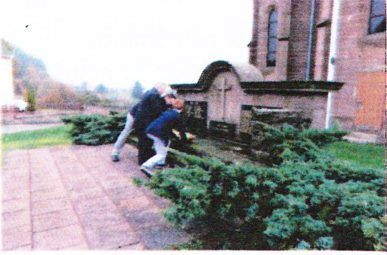
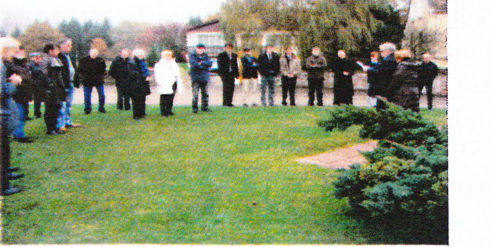
On 11 November, the municipal council and some of the residents gathered at the war memorial, where the mayor read the message from the Minister for Veterans in memory of the victims of the Great War (1914-1918). The atmosphere was one of reflection. Those present observed a minute’s silence and sang the Marseillaise, and the mayor laid a wreath at the foot of the war memorial. Humanity has a duty never to forget the horrors of this war, which claimed several million victims.
We hope that in 2014 our young people will come in large numbers to the ceremony marking the centenary of this conflict, the deadliest Europe had ever known.
CARBON MONOXIDE: AN INVISIBLE, ODOURLESS, TASTELESS GAS
In France, 100 people die from it every year!
What are the signs of poisoning?
- Unexplained tiredness, dizziness, nausea, vomiting, headaches, blurred vision.
- Loss of consciousness, even coma and death.
What to do in case of poisoning:
- Stop all combustion.
- Open the windows immediately to let in fresh air.
- Call the emergency services: 18 for the fire brigade or 15 for the SAMU (ambulance).
- Leave the building and get everyone out.
Rules to avoid poisoning:
- Have your boiler serviced by a qualified professional before the cold season. Have a qualified professional check it thoroughly once a year. If you go away, you can leave it on low to protect your heating system from frost.
- Make sure the flue your boiler is connected to is in good condition, whatever it is made of (masonry, sections or lining, aluminium or stainless steel), and that it is completely clear and airtight. Chimney sweeping is compulsory twice a year.
- Use only occasionally mobile butane, propane or paraffin heaters, which give off combustion gases containing carbon monoxide and nitrogen oxide.
- Make sure your home is properly aired and ventilated; maintain the vents and keep them clear.
- Never heat your home with radiant panels designed for large, well-ventilated spaces, even if they have safety devices, nor with camping heaters meant for outdoor use, nor by turning on the oven with the door open.
- Use small water heaters without a flue only occasionally and for short periods (8 minutes maximum). They must be installed in a sufficiently large, ventilated room.
- Clean the burners of your gas cooker regularly (you should see a short blue flame at each hole); if they are clogged, the air-gas mixture is poor and the burner may go out, especially on low. A properly adjusted flame should not blacken the bottom of pans.
- It is forbidden to install a cooker hood with mechanical extraction to the outside in a room that also has an appliance connected to a flue. This can seriously disrupt the appliance. Choose a recirculating hood and consult an installer.
- In buildings with shared mechanical ventilation, make sure your building manager has the individual and shared safety devices serviced and checked.
- Never put back into use a heater or fireplace that has not been used for years, or only occasionally, without having it checked by an approved professional.
MILITARY CEREMONY IN EGUELSHARDT
As part of Army-Nation relations, the municipality of Eguelshardt and the Army’s Initial Military Training Centre have agreed to hold a military ceremony with a parade on Thursday 19 December 2013 from 4pm in the church car park, presided over by General Hingray.
Everyone is invited, especially the pupils of our school. Come along! We will share a drink after the ceremony. The event will be covered by the Républicain Lorrain, Radio Studio 1 and TV Cristal.
THIS MONTH’S DIARY
- Thursday 5: Christmas meal, Seniors’ Club, salle Rapin, from 12 noon
- Thursday 12: intergenerational get-together, Christmas baking workshop, Seniors’ Club, salle Rapin, from 1.45pm
- Saturday 14: school Christmas party, salle Rapin, 10am
- Thursday 19: military ceremony, church car park, from 4pm
- Tuesday 31: New Year’s Eve party, CIA, salle Rapin
THE LORRAINERS OF THE BANAT
The history of the Banat Swabians is little known to the general public. Mrs Marie Ott, who is passionate about local history, gave me a handwritten text recounting this tragedy, without however giving the sources of her study. Here is a summary.
The Banat is a region of Europe in the south-east of the Pannonian Basin, divided on 13 March 1919 between Hungary, Romania and Yugoslavia. A former Turkish possession, it became Austrian in 1718 under the Treaty of Passarowitz.
Ravaged by the Turks, the land was a marshy wilderness. Austria therefore called for emigrants, who came in successive waves from 1718 to 1795, with their journey paid and material help. In fact, Empress Maria Theresa of Austria, wife of Duke Francis Stephen of Lorraine, called on as many subjects as possible from her husband’s former states, the duchies of Bar and Lorraine. 20,000 Lorrainers – more than 6,000 families – settled in the Banat; most came from the Sarreguemines area and the Pays de Bitche. Others came from Alsace, Luxembourg, the Saarland, the Rhineland, the Palatinate and Burgundy.
Gruelling work awaited them. Through sheer courage, in merciless conditions, they turned the marshlands of the Banat into a rich granary for Central Europe.
In the first year, most of the settlers died from the very harsh living conditions, from fevers carried by marsh flies, from plague and cholera. New settlers followed and carried on the work.
Die Ersten fanden den Tod – The first found death;
Die Zweiten die Not – The second found hardship;
Die Dritten das Brot – The third found bread.
They always kept their languages, including our Franconian dialect, their customs and their traditions.
During the Second World War, the occupiers regarded them as Volksdeutsche and treated them like the people of Alsace-Moselle. They were forcibly conscripted into the Wehrmacht and the SS.
After the war, the Yugoslavs shot Banat Swabians en masse. Survivors starved to death in Tito’s concentration camps, and when Russian troops advanced from Vienna towards the Banat, they decided to eliminate the survivors. Some groups nevertheless managed to escape. Robert Schuman intervened personally and directly with the Russians to save between 7,000 and 10,000 of them…
One group settled in the Vaucluse; the others scattered across 17 different countries, many in South America.
According to Mrs Ott, a few families with roots in our area still live in the Banat, keeping their language and religion.
In the name of remembrance, I felt it my duty to share this tragic story with our readers.
Emile Eitel
EGUELSHARDT: GETTING TO KNOW OUR VILLAGE
Eguelshardt has a total population of 571 (including the Étoile du Matin), with a household population of 443. It has grown steadily since 1975 (+0.7% a year since 1982). In 2009 (latest figures) the village had 158 households.
In 2009 there were 230 dwellings, including 158 main homes and 55 second homes. 90% of main homes have 4 or more rooms; 96% have a bathroom or shower; 71% have central heating.
30% of main homes were built before 1949, 24% after 1990. Between 2005 and 2011, 9 detached houses and 4 grouped individual homes were authorised.
205 working-age people live in the village, 87.5% of whom have a job, as manual workers, employees or in intermediate professions. They work in the village (18%, 33 people), in Bitche (31%), in Sarreguemines (12%) and in Alsace (22%, mostly in Haguenau).
There are 62 jobs in the village, 76% of them salaried, held by people living in the village (60%) or neighbouring villages. The private school is the largest employer. Only 2 part-time farmers remain (one rearing sheep, the other cattle), working 47 hectares. 8 businesses are registered with the Chamber of Commerce, including 1 local shop, 2 restaurants, a fish farm, a kennel, 2 timber merchants and a ceramics shop.
Source: OTE Ingénierie, Illkirch (Bas-Rhin), which is drawing up our local urban plan (PLU).