
Eguelshardt has not always been a village. At the beginning of the 18th century there was only a farm and a handful of families here. The water of the Falkensteinerbach, the timber of the forests and the work of mills, forges and sawmills gradually gave birth to the village we know today.
A border land
The name first appears in 1329, as Egelshart. The valley was then overlooked by Waldeck Castle, which passed in 1337 to the Zweibrücken-Bitche family and in 1571 to the Duke of Lorraine. From 1594, Eguelshardt was a mairie (administrative district) of the lordship of Bitche.
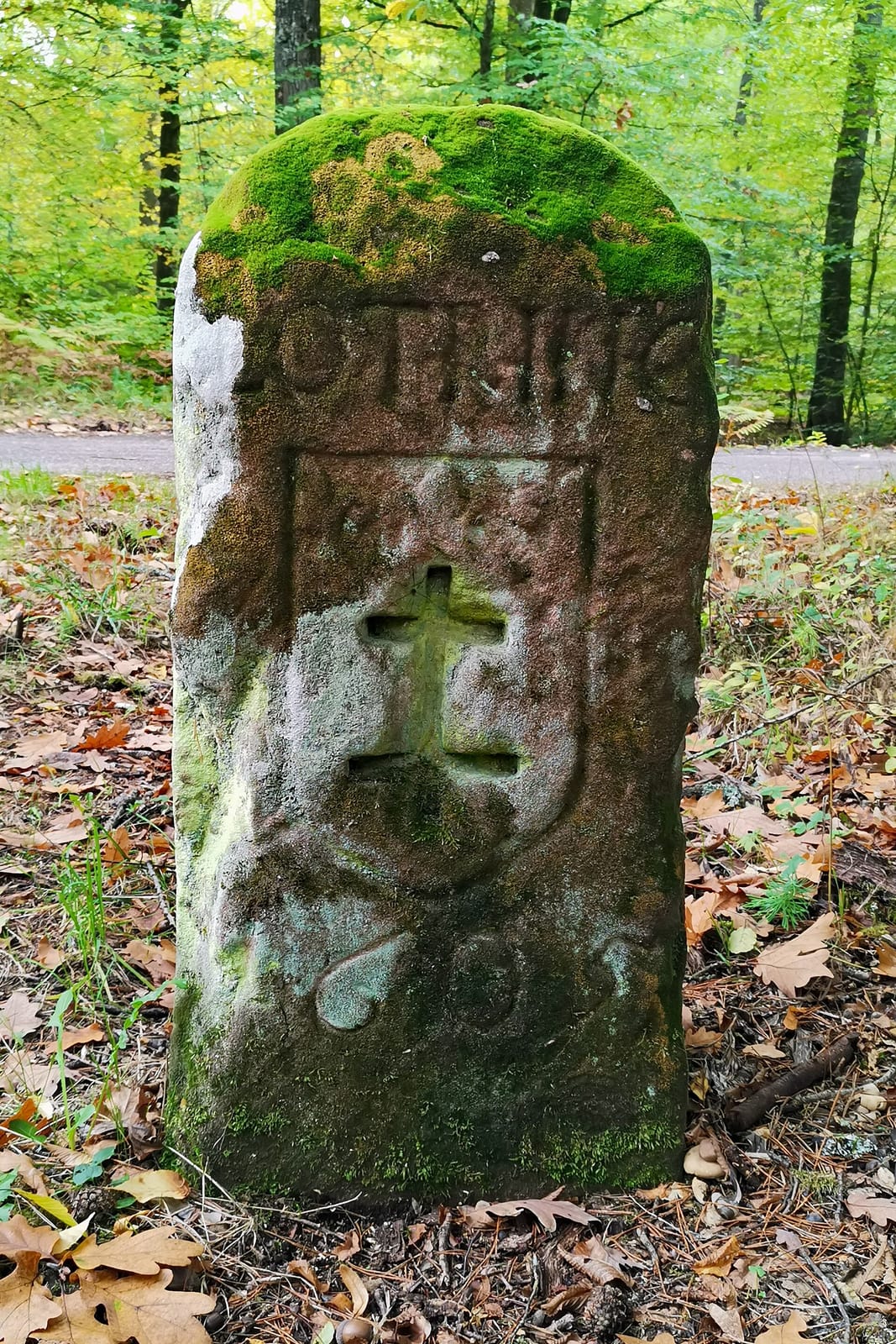
The village lies on the old border between the Duchy of Lorraine and the County of Hanau-Lichtenberg. From 1603, a line of sandstone boundary stones was set out to mark this border, most of them between 1605 and 1608. The hamlet of Bannstein, whose name comes from the Old High German Ban, “defence”, recalls these stones. Several of them, carved with the Cross of Lorraine, can still be seen in the forest.
Ruined by the Thirty Years’ War
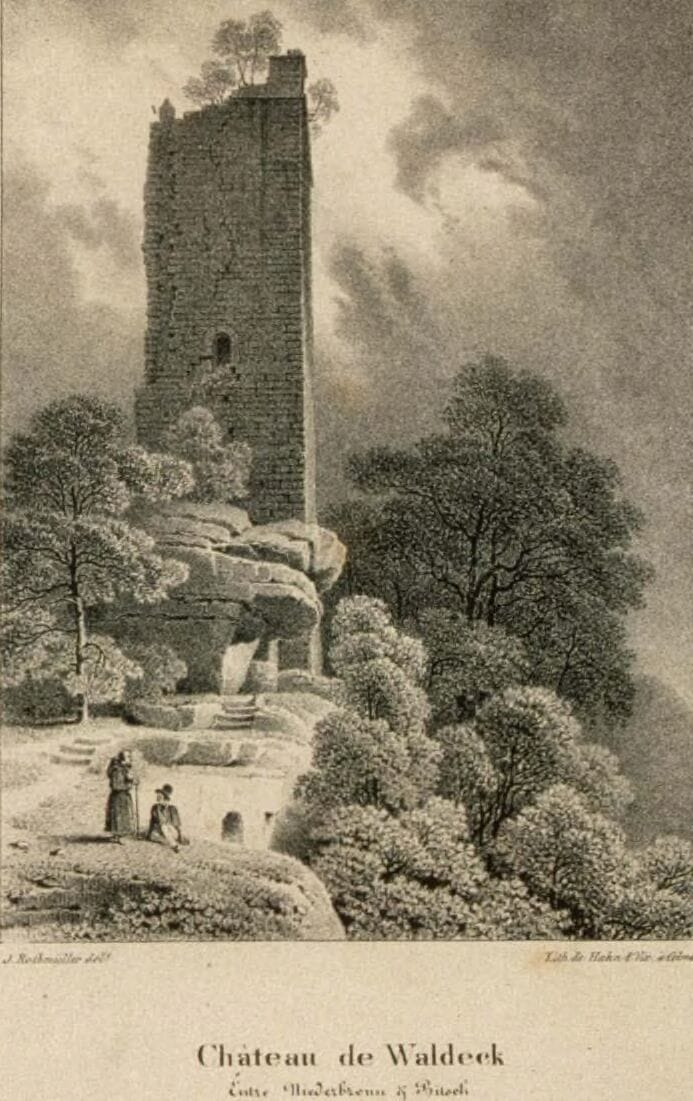
The wars of the 17th century emptied the region. As early as 1592, the Eguelshardt farm was recorded as being in ruins. In 1635, during the Thirty Years’ War, French troops under Marshal de La Force dismantled Waldeck Castle. In 1661 the village was still abandoned and “completely destroyed”.
People came back slowly. In 1708, Eguelshardt and Waldeck each had only three families, about thirty-five people in all. In 1732, with some ten families, the place was still described as a simple farm. By 1750 it had a hundred and fifty souls.
Water, wood and iron
In the 18th century, the trades set up along the Falkensteinerbach turned Eguelshardt and its dozen outlying hamlets into a village: mills, sawmills, forges and paper mills used the power of the water and the timber of the forests.
- The mill, already mentioned in 1594 and in ruins in 1721, was rebuilt around 1730 and ran until about 1855–1860. The sawmill next to it worked until 1945.
- The miller’s farm, below the church on the road to Waldeck, was built in 1767 for Jean Dubernel and his wife Anna-Maria Stuhl.
- The Bannstein forge, fed by the Bleiweiher pond, was probably working from 1760. A decree of the King’s Council of 25 May 1768 licensed it to make sheet iron, wrought iron and tool iron. The royal engineer who inspected it on 15 October 1788 found it “of old construction but in fairly good condition”, with two hammers and two forges driven by water wheels. Seized as national property during the Revolution, it became a sawmill, later bought by the de Dietrich family of Niederbronn, and remained in business until 1925.
New hamlets grew up around the village: the Schweizerländel in the mid-18th century, Erbsenthal and Glasbronn in the early 19th century, Eichelsberg in 1845, then Hof and Hubel, which are now part of the village.
A parish and a church
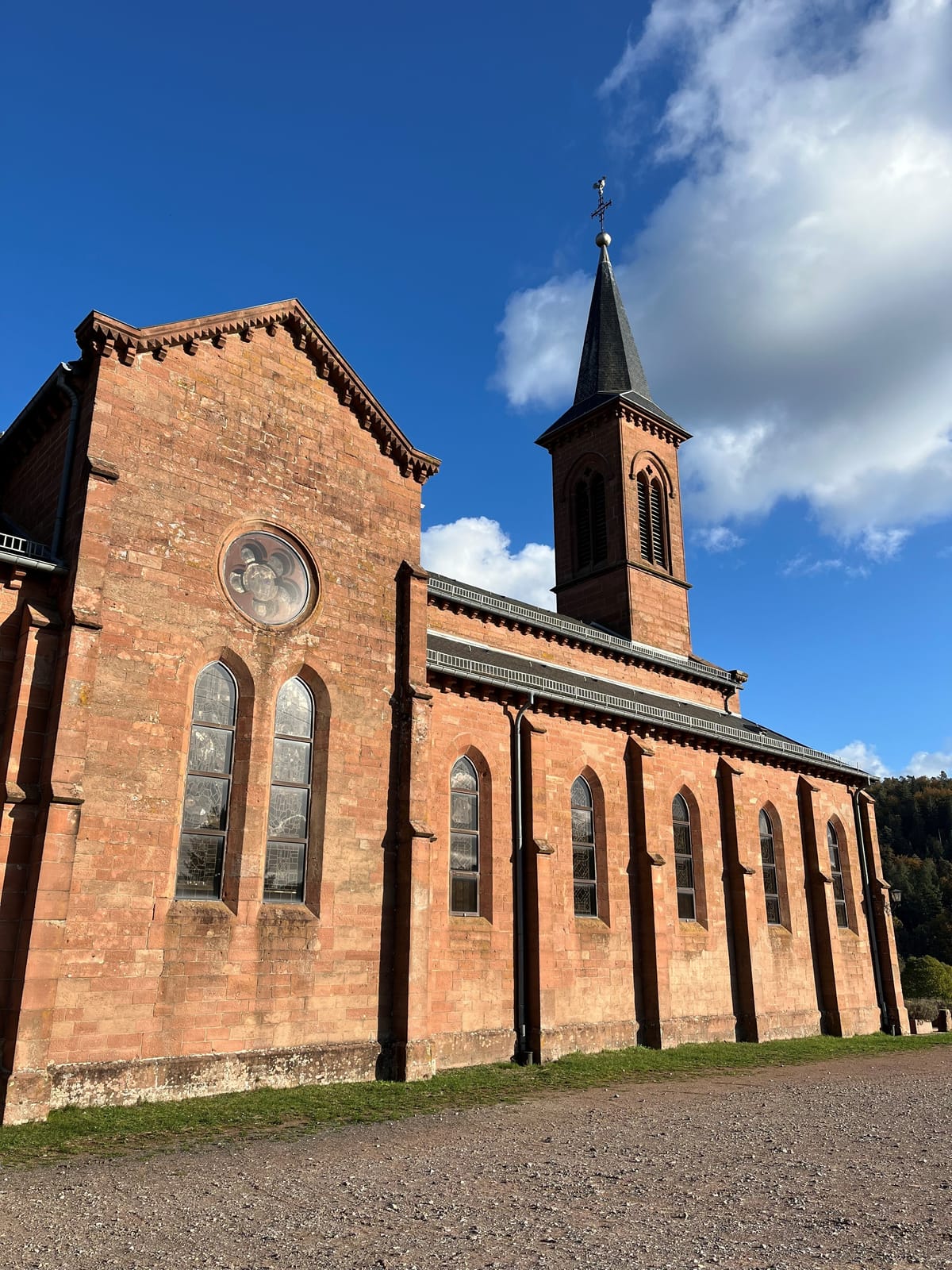
Long a dependency of the parish of Schorbach, Eguelshardt had a chapel dedicated to the Exaltation of the Holy Cross, rebuilt in 1770. The village became a parish of the archpriesthood of Bitche in 1802. As the population grew, a new neo-Gothic church of pink sandstone was built from 1854 to 1858, and the old chapel in the cemetery was then demolished.
The road, the railway and the annexation
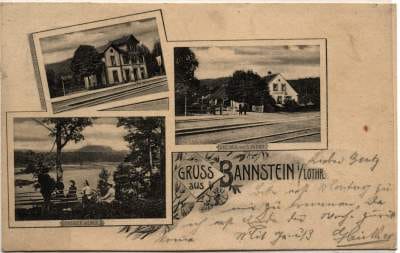
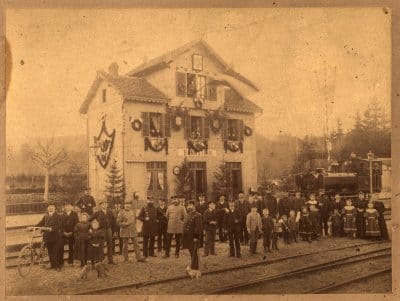
In the 19th century the village opened up to the outside world. The road from Niederbronn to Bitche was built in 1824–1826, and the railway line to Bitche opened in 1866–1869. The hamlet of Bannstein, which had only three houses around 1800, grew up around its station. The population rose from 265 in 1817 to 477 in 1852.
After the war of 1870, the Moselle was annexed to the German Empire and the village was called Egelshardt until 1918. The 1882 census counted only 403 inhabitants.

The village’s story continues here: Eguelshardt in the Second World War.
Images: boundary stones, PaulT (Gunther Tschuch), Wikimedia Commons (1, 2), licence CC BY-SA 4.0; Waldeck Castle, J. Rothmuller (1839), Bibliothèque nationale de France, public domain; Bannstein postcards (1, 2), Wikimedia Commons, public domain. Sources: French Wikipedia (Éguelshardt, Bannstein), bitscherland.fr, Joël Beck, Les moulins et scieries du Pays de Bitche (1999).


